


Classification and structural characteristics of tractor units
Dec 12, 2025
The tractor unit is the power source in a truck train assembly, used to tow trailers to achieve truck train transportation operations.
Classification by attachment method
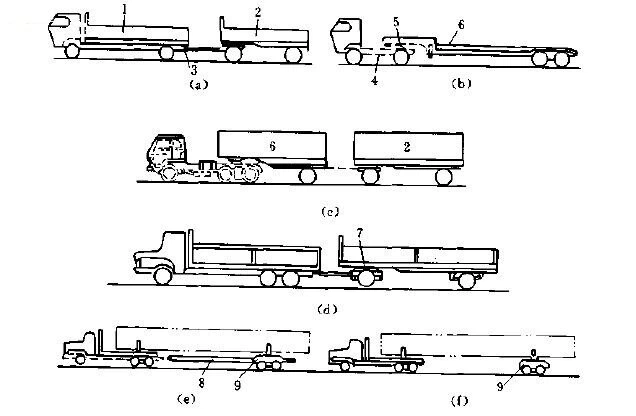
Full trailer tractor: A tractor that tows a full trailer. Its frame has a tow hook on the rear beam, which connects to the hook on the trailer and drives the trailer, as shown in Figure (a) below.
Semi-trailer tractor: A tractor specifically designed for towing semi-trailers. These tractors typically do not have a cargo box; instead, a towing seat is mounted on their chassis. The towing seat supports the load at the front of the semi-trailer and locks the towing pin, thus driving the semi-trailer (see Figure (b) below).
Special trailer tractor: Used for towing special trailers. This type of tractor is usually connected to the cargo using a rotating headrest, as shown in figures (d), (e), and (f) below.
Classification by Drive Type
4×2 tractor units have relatively low traction and are mostly used in high-speed truck trains (see Figure (a) below).
6×4 tractor units increase the load-bearing capacity at the towing seat (see Figure (c) below).
6×6 tractor units have high load-bearing capacity, high traction, and high climbing ability, and are generally used in larger military vehicles (see Figure (d) below).
8×8 tractor units are used in heavy-duty trucks and are generally used in large military vehicles.

Classification by Purpose
Tractors can be classified by purpose into cargo tractors, semi-trailer tractors, and yard tractors.
Cargo tractors: These serve both towing and cargo-carrying purposes, used in full trailer trains or special trailer trains.
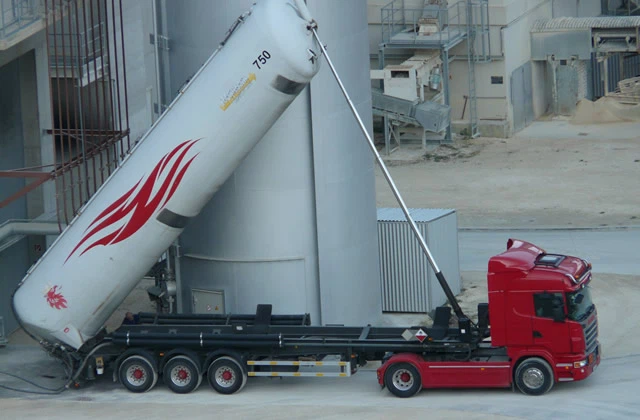
Semi-trailer tractors: These serve only towing purposes, used in semi-trailer trains. They are equipped with a towing seat on their frame to support and tow semi-trailers.
Yard tractors: These are used in airports, railway platforms, and ports, and can tow semi-trailers or full trailers.
Structural Characteristics of Tractor Trucks
The overall structure of a tractor truck is basically the same as that of a cargo truck, consisting of an engine, chassis, body (cab), and electrical equipment. However, because tractor trucks must perform towing operations, different requirements are placed on certain assemblies and components, especially for semi-trailer tractor trucks and tractor trucks used in yards.
1. Overall Chassis Layout
Compared to ordinary trucks, semi-trailer tractors have a shorter wheelbase and a larger load at the towing seat.
2. Transmission System
The transmission system of a tractor unit is basically the same as that of a truck. However, some tractors install a hydraulic coupling and a torque converter between the clutch and the transmission to ensure smooth starting. Due to the high driving force of heavy-duty tractors, a two-stage final drive is often used. Some also use a dual-speed final drive and wheel-hub reduction gears.
3. Braking System
The braking system of a tractor unit is basically the same as that of a cargo truck. The differences are that the tractor unit has pneumatic brake lines for supplying compressed air to the trailer, emergency brake lines, start control lines, and air connectors. Additionally, a handbrake valve is installed in the cab for direct operation of the trailer brakes. To improve braking performance, some tractor units are equipped with a load-sensing valve at the rear axle to improve the optimal distribution of braking force between axles.
4. Suspension
The suspension of a tractor unit is basically the same as that of a cargo truck. However, some tractor units, in order to improve performance and adapt to heavy load requirements, use independent suspension or leaf springs that are wider and thicker than those used in ordinary cargo trucks. For tractor units with dual rear axles, the rear suspension almost always uses a semi-elliptical leaf spring balanced suspension.
5. Chassis
The chassis is relatively short. The rear of the main chassis longitudinal beams is reinforced to bear several loads from the traction seat, and the arrangement of the crossbeams should also be considered accordingly.
6. Running System
For semi-trailer tractors with a load capacity of 16 tons or more at the traction seat, the running system is developed using a dedicated chassis.
7. Electrical System
A seven-pole electrical connector is extended from the tractor unit to connect to the trailer's seven-pin plug, enabling the transmission of electrical signals to the trailer.


