


What to do if the particulate filter is clogged?
Feb 15, 2025
We all know that gasoline combustion will definitely produce a lot of exhaust gas, some of which are harmful gases and some are harmless gases. Harmful gases cannot be discharged at will, and they need to be catalyzed by the three-way catalytic converter to cause them to undergo oxidation-reduction reactions and become harmless gases before being discharged. In addition to these harmful gases, the products after combustion will also contain some tiny smoke particles. For example, the carbon deposits we see in the cylinder are formed by the accumulation of these tiny particles.

The particulate filter is made of porous ceramic material, with dense bag filters inside, showing a honeycomb with a certain pore density. By alternately blocking the honeycomb porous ceramic filter, the exhaust gas is forced to pass through the wall of the channel, and the particles are captured and filtered by diffusion, interception, gravity and inertia. The filtering effect is very good, and it can filter out more than 90% of the smoke particles, that is, most of the granular impurities will be filtered out.
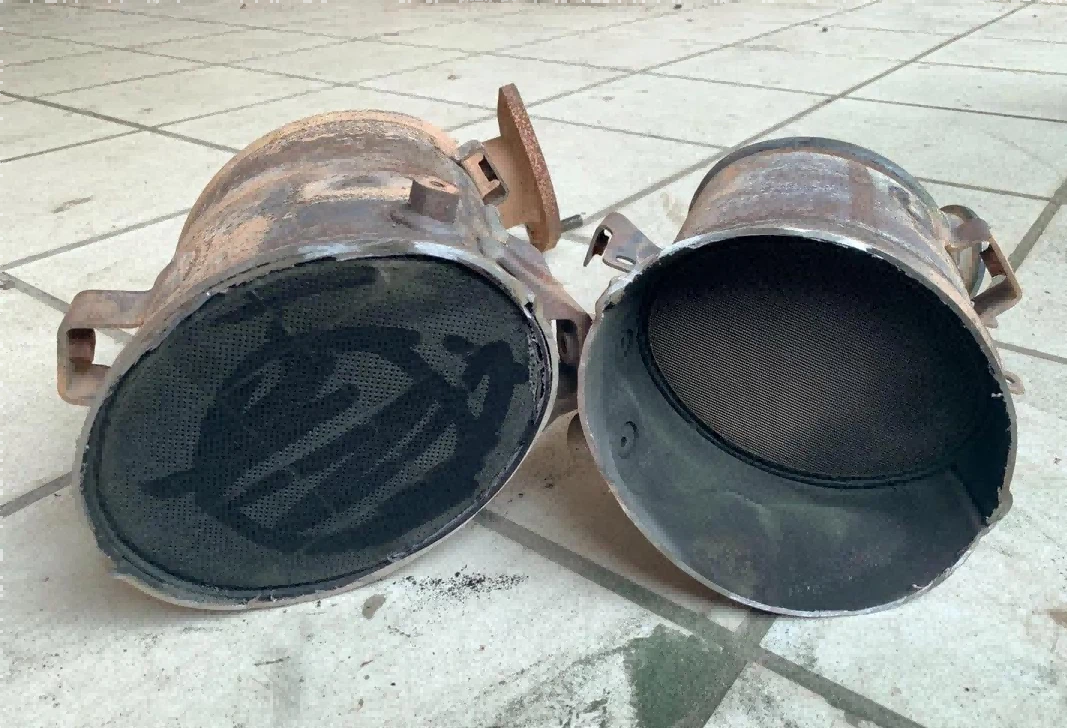
As long as the vehicle is started, smoke particles will be continuously generated, and the number of particles filtered out by the particulate filter will increase. Will it be blocked? In fact, the particulate filter not only has a filtering function, but also a regeneration mechanism. When the temperature in the particulate filter reaches 550℃, the captured particles will be oxidized, decomposed and burned, and then converted into harmless gas to be discharged. In this way, they will not accumulate inside the particulate filter all the time, and long-term recycling can be achieved.
Under what circumstances will the particulate filter be blocked? First, the temperature of the particulate filter is too low, not reaching 550 degrees, and it is unable to decompose the filtered particles. Second, there are too many filtered particles and they can no longer be oxidized and decomposed. Once the blockage causes the exhaust to be blocked, the vehicle will have problems such as poor acceleration, slow speed, and the fault light will be on, making it impossible for the vehicle to operate normally and requiring repairs.
What should you do if there is a blockage? If it is a minor blockage, you can just drive on the highway. Drive your vehicle on the highway, increase the speed to more than 100, and drive for half an hour, and it will basically be solved. Doing so can not only increase the exhaust temperature, but also increase the exhaust airflow, which has a certain flushing effect on the particulate filter.
If the blockage is serious, you need to go to a maintenance station for repair, usually by using a computer to control the engine or re-updating the program, that is, increasing the engine speed and using the regeneration function of the particulate filter to allow the blockage to decompose and burn itself.
If the blockage is particularly severe, you will have to remove it for cleaning or replace it with a new one.


