


Increase power and save fuel, just change your driving habits!
Aug 21, 2024
Each engine has its own working condition characteristics, running in the efficient working condition zone can maximize the use of energy and maximize efficiency.
In general, the most common way to see how well an engine is characterized is to look at the engine's external characteristic curve. It is a graph of horizontal and vertical coordinates, plus 2 curves. One curve represents the power of the engine and the other curve is the torque of the engine.

By looking at the external characteristic curve of the engine, we can understand the pattern of change between engine torque, power and speed. Most directly, it is possible to know the starting and ending points of maximum torque, and this section of the range is almost always the best interval for shifting gears to ensure maximum power.
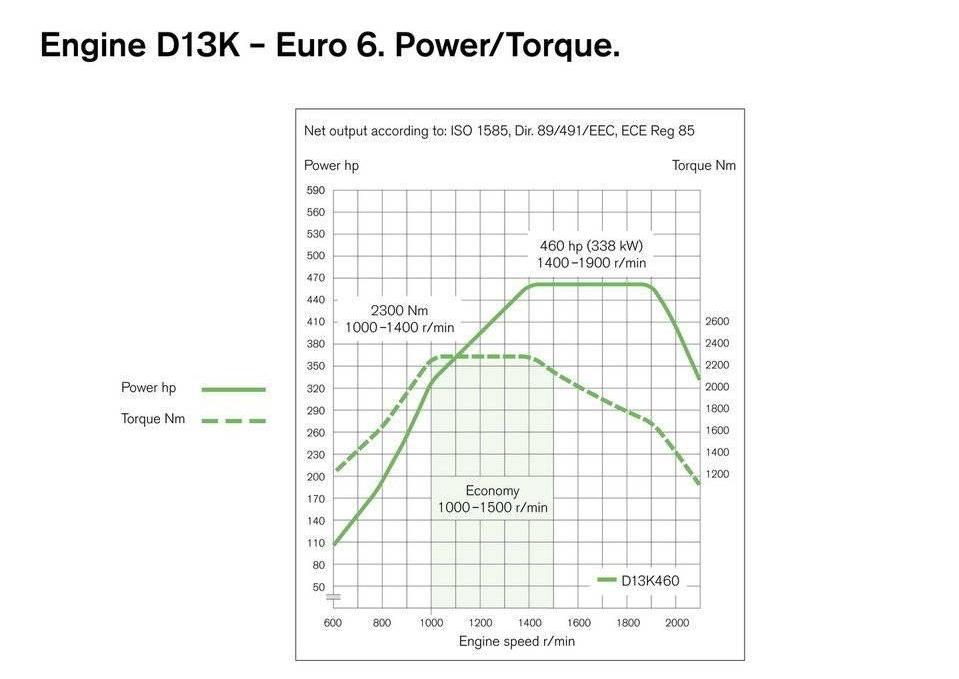
But how to save fuel is not shown by the external characteristic curve of a typical engine. The Volvo's external characteristic curve is made more user-friendly, with the most economical rev range marked directly in green.
In addition to the X- and Y-axis, which are common in coordinate charts, there are also curves like map contour lines, which look very complicated, but are actually quite simple to understand.

In this graph, the X-axis is engine speed and the Y-axis is torque.
The solid line in the coordinate chart is the iso-fuel consumption rate curve, and the value is the specific fuel consumption of the engine, with larger numbers indicating higher fuel consumption in this interval in g/(kW.h). The dashed part is the iso-power curve of the engine.
The universal characteristic curve is essentially a synthesis of all load and speed characteristic curves. It can represent the engine in the whole working range of the main parameters of the change relationship, with which you can determine the most economical engine working area, a certain emission of pollutants in the region of the minimum value, and so on.
Matching parameters so that these optimal performance regions fall within the most commonly used operating conditions is one of the key principles of engine performance matching.

After figuring out what the individual lines do, we can arrive at the optimal efficiency interval, which is the smallest area of the circle in the figure.
As you can see, this maximum efficiency range is relatively small. By keeping the engine speed at 1250-1500 rpm, when the torque is close to the peak level and the specific fuel consumption is only 198 g/(kW.h), you can get into the most fuel-efficient state of the engine.
However, it is not possible to keep shifting in this range all the time during use. Revving too high or too low will result in higher specific fuel consumption. At this point the engine's fuel consumption comes up. The direct feeling is that the vehicle becomes more fuel-intensive.
Fuel saving is a systematic project, but the engine is the most important factor, and figuring out its characteristics can be very beneficial to the operation.


